Replaying a Day-Trading Signal Without Using the Future
Build a timestamped replay record that separates chart hindsight, information availability and executable order evidence.
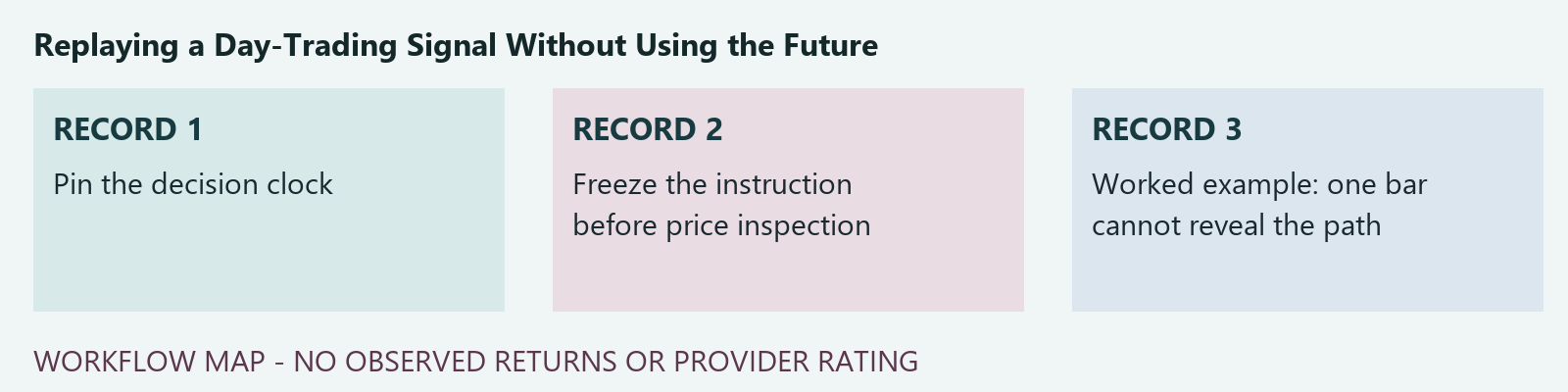
Pin the decision clock
Identify the exchange session, time zone, daylight-saving convention and when each input became available. A candle timestamp may describe the start or end of its interval; that meaning affects which prices the decision could have observed. Save publication and receipt times separately. A label such as intraday does not define a latency assumption, closing deadline or exact instrument. The replay must begin with the instruction and information clock, not with the later candle that makes the entry look attractive.
Freeze the instruction before price inspection
Retain entry condition, intended order type, expiry, stop, target and amendment policy as originally stated. If a field is absent, leave it absent in the replay rather than constructing a sensible rule after observing the move. Preserve the earliest executable decision under the declared convention. SEC order documentation defines general order limitations but cannot show which order a subscriber placed. A replay under assumptions is a different evidence class from an account trail containing acceptance, fill and cancellation events.
Worked example: one bar cannot reveal the path
Invent a bar with open 100, high 104, low 97 and close 102. An entry near 100, stop 98 and target 103 could encounter both exit levels inside the bar. The four summary prices do not reveal which level came first after a valid entry. Mark the outcome ambiguous under this data resolution. Do not select the favourable order or call the bar a verified win. Finer observations may help resolve sequencing, but they still need availability and fill conventions before becoming an execution claim.
Keep unavailable and unfilled calls visible
Record signals received after expiry, signals outside your monitored hours and orders that never filled. These states should not be folded into a closed-trade win rate without a declared population rule. A provider's original call result and your account outcome can legitimately differ. Maintain both with their own denominators. Avoid replacing missed observations with interpolated trade prices unless a predeclared research convention explicitly allows an approximation and labels it as such.
Preserve costs and simultaneous exposure
A rapid sequence of small favourable moves can produce a different account result after repeated charges or overlapping positions. Define whether prices are mid, bid, ask or actual fills; then list explicit fees and any additional cost assumptions without double counting. Record partial exits and the remaining quantity. A session-level summary should include open exposure at the reporting boundary, not merely closed winners. Changing the replay rule after an adverse result belongs in a new version, not an invisible correction.
Publish the replay boundary
The deliverable identifies the instruction version, input source, time convention, data resolution, ambiguity rule and output status. State whether the exercise is a hypothetical reconstruction or a review of real account events. Time-aware cross-validation documentation helps frame research separation, but a chronological split alone does not validate the trading assumptions. No paid day-trading service was tested by this guide. Its purpose is to make a replay inspectable and prevent a completed chart from silently deciding what an earlier trader could have known.
Decision record
| Question | Record to retain | Decision boundary |
|---|---|---|
| Clock | Session, time zone and input availability | A bar label is not necessarily decision time |
| Instruction | Original version and missing fields | Later price action cannot fill omitted rules |
| Path | Observation resolution and ambiguity policy | OHLC alone cannot order two intrabar exits |
| Account | Fill, cost and remaining exposure trail | Hypothetical replay is not broker execution |
Blank working record
The worksheet contains column headings only. Enter your own dated observations, keep absent evidence marked unknown, and do not treat the file as certification.
 Download worksheet (CSV)
Primary references
These documents support mechanisms and source definitions, not a tested trading result or a recommendation. Accessed 9 October 2026. The decision workflow and invented examples above are editorial exercises.
Keep reading
Publication methodology | Working glossary | Source and correction policy